Wartime Worries of Fanny Palmer Austen and Jane Austen

During the long Napoleonic Wars both Jane and Fanny Palmer Austen feared for the safety of men in their interrelated families, and with good reason. Jane’s two naval brothers, Charles and Francis, were continuously involved in the hostilities. They served in the British navy in the Mediterranean, the North Sea, the Baltic, and in British home waters, as well as across the Atlantic in North America and the West Indies. At times they were at great risk, in particular Francis, when he took part in a major action, by leading the lee line into action at the Battle of San Domingo (1806). Either brother might have been captured and made a prisoner- of-war[1] or been wounded and failed to recover. At home in England, Jane responded with evident and continuing concern for her brothers’ well being,

Since Fanny Palmer had married Jane’s brother Charles, she had her own immediate apprehension for his safety. She feared for Charles, especially when he was sent on mission into the European war zone. Her letters during his years of service on the North American Station (1805-1811) express the depth of her anxiety. In addition, her only brother, Robert John Palmer, was detained in a prisoner-of-war camp for at least 8 years within Napoleonic France. His unhappy story is related here from contemporary documents that reveal how he came to be captured and provide an idea of the life in a prisoner-of-war detention centre. Details of this story illuminate Fanny’s particular worries as a sister in wartime, while her letters show how she and her family responded to his plight.

Robert John Palmer’s route to detention began with his trip to North America in 1805. Since August 1802, the twenty-one-year old Robert had been articled in London to his father’s first cousin, John Palmer, who was a member of Gray’s Inn. The purpose of Robert’s trip was most likely legal business for his uncle,[2] though he probably stopped in Bermuda, where his father had property interests and his two sisters, Esther and Fanny, were living. Whatever the specifics of his mission to America, in late May his business was completed and he boarded a mail packet, the Lord Charles Spencer, in Halifax, Nova Scotia enroute to Falmouth, England. It was a voyage of unwelcome surprises.

 On 15 June, off the west coast of Ireland, the packet was sighted and pursued for eight hours by its eventual captor, the 30 gun French privateer, the Valliant. The unlucky passengers together with their baggage were detained and transported to San Sebastian in Spain. Family members waited uneasily for news of their loved-one’s fate. Eventually, on 27 July, British newspapers listed those passengers who had been returned from Spain to Falmouth. Robert John Palmer’s name was not among them. For reasons unknown, he was sent to the prison depot in Verdun, a fortified town in the province of Lorraine in northeastern France. Proof of his incarceration is found in an official list of English prisoners at Verdun (19 November 1806). It includes “Robert John Palmer, passager [ captured with] le Paquebot Lord Charles Spencer,” further described as “etudiant en droit” (law student).[3] Palmer was considered a “détenu”, that is a civilian who was apprehended in enemy territory after 1803.  

Fig.1: List of prisoners at Verdun in 1806, including Robert John Palmer.

Fig.2:  Fortress at Verdun, France[4]

For the next eight years, Fanny worried about her brother’s well-being. English nationals in prisoner of war camps were trapped, cut off from family and friends. Napoleon officially stopped all correspondence with England in 1806. Letter writers risked punishment, and the underground transmission of letters by smugglers was untrustworthy, difficult, and very expensive.[5] Fanny, along with her parents and sisters, Esther and Harriet, could only speculate about the circumstances of Robert’s incarceration.

Snippets of information about Robert’s life in the camp appear in several of Fanny’s letters. In early February 1814, she had met a Captain Wallace who had been at Verdun. He described her brother as “an excellence character ... who keeps the very best company, [including] a Colonel in the Army” [with whom he] rides every day”[6] (5 February 1814). This report suggests that Robert was on parole, having given his word he would not try to escape. It meant that he could live in town at his own expense and venture a short distance into the countryside.

Fig. 3: Pass Issued to a British prisoner at Verdun.

Fanny probably knew there were opportunities for entertainments at Verdun. Several social and gaming clubs held balls and assemblies. Theatrical performances, cockfighting, duck hunting and horse races occurred.[7] This range of amusements makes incarceration sound tolerable, even amusing, but the extent of a prisoner’s financial resources would clearly have controlled his comfort and quality of life.

Whether the Palmer family found a way to transmit money to Robert is unknown. Remittances sent privately to prisoners from England were stopped after 1806. The transfer of bills of exchange was also blocked and French bankers were forbidden to discount prisoner’s drafts on London.[8] Even if the Palmer family sent money to Robert, it is doubtful how much actually reached him and what lifestyle he could afford to sustain. Significantly, Fanny’s pocket diary from early 1814, records that she “Lent RP £4,” a not insignificant sum given the scope of Fanny’s careful domestic budgeting. Presumably, the initials refer to her brother.

Even if he could afford some of the local diversions, Robert would not have found his life as a captive in Verdun meaningful and fulfilling. Over a period of at least eight years, the ephemeral social and sporting pleasures no doubt paled in interest through repetition. The irrefutable fact remained that Robert’s freedom of movement was rigorously restricted.   

Fanny refers to her brother in correspondence with her sisters as “poor John,” (John being the name used for him within the Palmer family). Fanny’s words suggest her empathy for him, stuck in such a frustrating and uncertain situation. Qualms and anxieties about the future, extending over his years of incarceration, must have taken a toll on Robert’s spirits.  Like other prisoners-of-war, he presumably feared the consequences should France win the war. Perhaps he hoped for a prisoner exchange but it was unrealistic to expect he would be favoured for inclusion.[9] Although the  French had made overtures regarding prisoners in 1810  and an expectation grew that an agreement could be reached, ultimately the British found the French terms unacceptable. The 11,358 British military prisoners and 500 detainees, Robert included, remained in captivity.[10] In effect, Robert’s life was on hold and his legal career stalemated.  

In the 19th century marriage established an inter-family attachment so when Fanny became an Austen in 1807, Jane likely paid attention to the welfare of Fanny’s siblings, including the plight of her brother as a detainee. Significantly, Jane wrote a prayer which expressed her heartfelt concerns about those adversely affected by war. The text reads: “Heartily do we pray for the safety of all that … travel by sea... and that thy pity may be shewn upon all captives and prisoners.”[11] Her naval brothers were among the travellers by sea; Robert John Palmer had been a traveller by sea and was now among the “captives and prisoners.” Jane’s wording suggests she harboured very personal sentiments for these men. Her prayer also appears to petition for the humane treatment of prisoners in the request that “pity may be shown on all captives.”  

Fig. 4: Captured British Midshipmen Being Marched to Their Prison-Depot at Verdun

As long as the Napoleonic Wars continued, Jane and Fanny Austen both felt anxious about the vulnerability and adverse consequences for their loved ones. Would Charles and Francis continue to avoid capture, or worse, incarceration? Would Robert cope with the stresses of long-term captivity?  These shared worries in wartime must have nourished a growing bond between Jane and Fanny Austen.[12] 


This essay first appeared in The Jane Austen Society Report for 2021.

[1] Sources show that some British naval officers were detained as prisoners at Verdun. They included Lt Barker, Lt Tuckey of HMS Calcutta, Captain Brenton of HMS Minerva, and Lt Dillon. See Edward Fraser, Napoleon the Gaoler, Personal Experiences and Adventures of British Soldiers and Sailors during the Great Captivity, Brentano’s, 1914, 41, 45, 56.

[2] He was likely sent either to collect or exchange documents or complete a legal transaction. I owe this suggestion to Sandra Robinson.

[3]  See ADM 103/468 PART 1 (Prisoners of War 1715-1945).  Many thanks to Roy and Lesley Adkins and Sandra Robinson who alerted me to this document.

[4] Figs. 2,3 4 are from Fraser, Napoleon the Gaoler, 1914.

[5] See Fraser, 46.

[6] Fanny Austen’s Letters, 5 February 1814, reproduced in Sheila Johnson Kindred, Jane Austen’s Transatlantic Sister, MQUP, 2017, 2018.

[7] See Fraser, 41-44.

[8] See Fraser, 47.

[9] Several members of the aristocracy, including Lord Elgin and the Earl of Yarmouth, were among the detainees who were exchanged in 1806, but Robert was a mere law student and did not have their societal and financial status that would have enhanced his chances of being exchanged.

[10] See Fraser, 56.

[11] Richard Chapman, Minor Works, OUP, 1954, 454.

[12] What happened to Robert John Palmer? He was freed from Verdun in early January 1814 as the war was winding down. He was back in England by July but by Autumn he had fallen out with his parents and his sister Harriet in London, although not with Fanny, Charles and their young daughters. He supported the distraught and grieving Charles Austen, after Fanny’s unexpected death in September 1814, accompanying him at sea on his next ship, HMS Phoenix, for some months. Subsequently he married and made his home in Ireland at the Palmer family estate, Banemore House in Co. Kerry. In the next generation a son bore the name “Charles John Austen Palmer.” Jane’s brothers Charles and Francis survived the war and continued their careers in the navy. For details, see Brian Southam, Jane Austen and the Navy, National Maritime Museum, 2005.

Narratives of Naval Wives during the Napoleonic Wars: Fanny in Fact and Jane in Fiction.

Fanny Palmer Austen was married to Captain Charles Austen, Jane's brother. Her friendship with Jane allowed Fanny to share stories about her experience of the naval world. Later, Jane created naval wives in her novel, Persuasion. How might Fanny's life story have impacted Jane's writing?

I will be giving a talk on this topic on Zoom to the Eastern Washington Northern Idaho (EWANID) Region of the Jane Austen Society of North America on Saturday, November 6, 2021, at 11:00 am Pacific Time (3:00 pm AST). All are welcome.

This is a free event but registration is necessary. To sign up, you may go to the EWANID webpage: jasnaewanid.org/events/


Tags: Fanny Palmer Austen, Jane Austen, Naval Wives, Napoleonic Wars, Persuasion

Fanny, Jane and Seaside Watering Places

Dear Readers,

Due to writing deadlines, my next posts will be on 29 October and 30 December 2021. Keep safe.

Sheila

Introduction

In the early nineteenth century seaside resorts became a popular destination for relaxation and sociability among the gentry class. The vogue for sea air and sea bathing were motivating factors as were opportunities for refined entertainments and diversions. Jane Austen enjoyed sea bathing during family holidays at Sidmouth, Dawlish, Teignmouth and Lyme Regis between 1801 and 1804. Fanny Palmer Austen enjoyed similar pleasures of the seaside after she reached England in 1811. As the two sisters-in-law came to know each other better, they found they shared a mutual interest in all manner of activities relating to the sea, including the relaxing life at seaside resorts. Fanny had much to tell Jane about her experiences at sea and on shore, and Jane found cause to use her acquired knowledge of the seaside in writing her later novels. In particular, the phenomenon of the seaside resort became the setting for her last, unfinished novel, Sanditon.

Fanny at Southend

After the remoteness and often foul weather conditions suffered during the winter and spring aboard HMS Namur, Fanny Palmer Austen keenly anticipated summer holidays at a seaside resort. During 1812 and 1813, Fanny’s father, John Grove Palmer, arranged a holiday for his whole family at Southend, Essex.[1] The party included Fanny’s parents, her naval husband Captain Charles Austen, their young daughters, sister Harriet, and by times her sister Esther and her sons.[2] Southend turned out to be an excellent choice for the scheme. It was conveniently located 42 miles from London where the Palmers lived and a short distance by sea from the Namur at the Nore anchorage for Fanny and her children.[3] In addition, Charles could readily join them when he had shore leave.

 Southend was one of the up-and-coming watering places of the period. The resort’s early developers foresaw the virtue of creating a “new town” to the west of the original fishing village, on the cliff tops, at a sufficient elevation to ensure a pleasing and panoramic perspective. Its centrepiece was a row of smart houses available for rent, known as the Royal Terrace, so named after the visit of Princess Caroline of Brunswick, wife of the Prince Regent, in 1801. Adjoining the terrace was the Royal Hotel which contained a handsomely furnished assembly room suitable for balls and a coffee room. Adjacent to it stood a new building housing a Circulating Library. The layout included a north-south leading High Street and an adjoining road leading to the original lower town, where the Southend Theatre was situated. By the time the Palmer-Austen party frequented Southend, the buildings and amenities of the fashionable core of the resort were complete, so Fanny and her family were able to enjoy the variety of facilities it offered.

Fig 1: The Terrace Southend, 1808. Note the bathing machines waiting for clients on the shore.[4]

Fig 1: The Terrace Southend, 1808. Note the bathing machines waiting for clients on the shore.[4]

On fine days visitors greeted each other as they walked on the broad gravelled promenade along the Royal Terrace or descended through the attractive shrubbery on the cliff side, where criss-crossing paths invited access to the sand beach. The Royal Hotel offered multiple amenities for public gatherings and the proprietor, D Miller, advertised that “dinners [could be] dressed and sent out to private homes at the shortest notice.”[5] The hotel also provided “Bathing Machines with proper Guides,” a service that made good the promise that Southend offered “particular advantages … for the comforts and conveniences of sea bathing.”[6] Warm saltwater baths could also be had at a site below the Royal Hotel.  

Fig. 2: Sketch of the Royal Hotel[7]

Fig. 2: Sketch of the Royal Hotel[7]

After the isolation of life aboard the Namur, Fanny enjoyed the sociability of her immediate family as well as the varied company provided by the comings and goings of many other visitors. She likely met others, like herself, who were part of the wider naval world. Southend was a popular destination for shore-based naval families, including naval officers reuniting with wives and children while their vessels were being repaired at the close by Sheerness Dockyard. Fanny mentions socializing with a Lt MacNamara, a marine from the Namur, who was staying in Southend during the summer of 1813.[8] Other officers from the Namur may have also headed for Southend for relaxation and entertainment. In general, Southend “tended to attract the … quiet and cultured sort of visitor.”[9] This description, with its implied promise of congenial camaraderie, suggests that Southend would have suited the social interests of the Palmer-Austen party.

Georgian society of the period enthusiastically endorsed the health-giving properties of sea air and bathing. Fanny had already praised the virtues of sea air in letters to her family. Writing from aboard the Namur, she said of her sister, Esther, who was visiting in London, that a “change of air [would] be of great service”[10] and that the bracing sea air would “restore [your] appetite sooner than anything.”[11]  She does not mention who in their party enjoyed sea bathing at Southend. As for herself, Fanny was four months pregnant in 1812 so may have demurred, although one of her sisters, Esther or Harriet, possibly accompanied Fanny’s intrepid elder daughter, Cassy, into the sea. The child was a prime candidate for saltwater therapy after a difficult spring aboard the Namur where she was very prone to sea sickness. In later years sea bathing became an established practice for the Austen children, their grandmother, Mrs. George Austen, noting in 1815 that they were “better for the sea air and bathing"[12] after a seaside holiday at Broadstairs, Kent.

A particular bonus for Fanny was the presence of the Circulating Library situated next to the Royal Hotel. The wide development of such libraries afforded new freedoms to a woman of the gentry, - a freedom to go to the library unescorted, a freedom to choose a book for herself from a selection of titles with women in mind. Once Fanny joined, she was entitled to borrow books on a wide range of subjects, including the latest novels, biography, poetry and history. After periods of seclusion on the Namur, going to the library to choose a book with the prospect of returning for another was surely a pleasure. Circulating libraries also catered for other female tastes by stocking trinkets and decorative items such as fans, ribbons, jewelry, parasols and toys for children, as well as gloves and sealing wax. Here was an opportunity for a little frivolous holiday shopping should Fanny be tempted.

Fig. 3: The purpose-built Library is the building on the far right.[13]

Fig. 3: The purpose-built Library is the building on the far right.[13]

The Southend Theatre, opened in 1804, was another attractive destination. By 1810, actor-manager Samuel Jerrold was presenting a summer season of fully mounted productions, They included Adelgatha: or the Fruits of a Single Error, which promised patrons the sight of “Rocks, and a Waterfall, Grand Gothic Palace, Subterranean Cavern, and Grand Banquet.”[14] Fanny’s letters indicate that she enjoyed music and theatrical presentations, so whatever the playbill during Fanny’s time at Southend, a family outing to the theatre would be particularly enjoyable for her.

Southend and Sanditon Compared

Fanny was at Southend from July to September 1813. The following month, she and Charles with two of their children, paid a week’s visit to Godmersham Park, the estate of his brother, Edward Knight, where Jane Austen was also staying. The coincidence of their mutually happy visits afforded Fanny and Jane the opportunity to spend time together and to share family news, including anecdotes about Fanny’s Southend holiday. Although such information might be considered merely family chit chat, Fanny’s descriptions of the setting, as well as her opinions about the social and cultural dynamics at Southend, may have been of use to Jane when she began to create her own fictional watering place in her novel, Sanditon.

Sanditon is a satirical story about the alterations occurring in a little fishing village during its transformation into a profitable seaside resort. It touches on the themes of business speculation, hypochondria, health exploitation, escalating tourism and its effect upon rural communities and traditional values. The reader meets a cast of memorable and amusingly portrayed characters: Mr Tom Parker, landed gentleman and lately an enthusiast turned property speculator, Lady Denham, a rich widow, the grand lady of the village and the co-investor in Parker’s scheme, the hypochondriacal Parker siblings, Diana, Susan and Arthur, and their dashing brother, Sidney. Austen’s developing plot hinges on the activities and aspirations of other Sanditon inhabitants as well: the enigmatic, beautiful Clara Brereton, poor cousin of Lady Denham, the lecherous Sir Edward Denham who hopes to inherit from Lady Denham and marry wealth, a highly anticipated visitor, the half mulatto heiress Miss Lambe, and the heroine, Charlotte Heywood, who observes and judges the inhabitants and visitors to Sanditon as she contemplates the different illusions of reality about the resort which they entertain. Begun in January 1817, and left unfinished on 18 March, only 20% of the novel was completed before Jane’s death in July. Sadly, the reader can only guess at how the love interest would have developed among the young people and speculate about who will gain and who will lose, as the scheme to develop Sanditon proceeds.

Fig. 4: Jane Austen’s Sanditon with an Essay by Janet Todd (2019)

Fig. 4: Jane Austen’s Sanditon with an Essay by Janet Todd (2019)

The village of Sanditon and its social life bears some interesting resemblances to Fanny’s knowledge of Southend. Austen conveys a strong sense of Sandition’s physical features, both existing and planned by Parker, in order to engender a sense of the resort it will become. Such a place required a number of specific amenities all of which Fanny and her family found at Southend. Indeed, Fanny could convey her personal perceptions to Jane about the look and feel of Southend, along with a description of the layout of the purposely built Southend “new town.” [15] Intriguingly, a similar grouping of interrelated buildings appears in Sanditon. The scene is described thus: “about a hundred yards from the brow of a steep, but not very lofty cliff, [there was] … one short row of smart looking houses, called the Terrace, with a broad walk in front…. In this row [was] the library, a little detached from it, the hotel and billiard room - here began the descent to the beach, and to the bathing machines – and this was therefore the favorite spot for beauty and fashion” (chapter 4, 173).[16] In effect, there is a persuasive parallel between the physical layout of Southend as Fanny knew it and of Sanditon as Jane described it.

Fanny knew how important the fashionable core of Southend was for meeting, socializing and the sharing of news. She would be able to describe the dynamics of this social hub in some detail. She could recount how friendships were made and relationships advanced as individuals interacted in the environs of the Terrace, the Hotel and the Library. There is a similar busyness in Sanditon. Much of the interaction among the characters takes place on the promenade in front of the Terrace, in one of the Terrace Houses or at the Hotel.[17]

In addition, the Library in Sanditon is both a cultural and social centre. Sanditon’s heroine, Charlotte, is taken on an early visit there and invited to appreciate its merits, both in the line of books to borrow and trinkets available for purchase. In the novel, the library functions as an essential component of the resort experience, as it did for Fanny in Southend. It was another pleasurable feature of her holiday she could share with Jane, perhaps even telling her what books she had borrowed.

A further benefit of a visit to a seaside resort was thought to be the healthful effects of exposure to sea air, and even sea bathing. Fanny had praised the restorative virtues of bracing sea air in letters to her family.[18] In Jane Austen’s Emma (1815), it is the apothecary, Mr Wingfield, who advises John Knightley to take his family to a seaside resort, prescribing “for all the children, but particularly for the weakness in little Bella’s throat, - both sea air and bathing” (Emma, chapter 12). Austen specifically named their destination, “South End.” Later in Sanditon, Austen mentions “a family of children who came from London for sea air after whooping cough” (chapter 4, 172). This behaviour is resonant with the views and practices of Fanny’s family.

As Jane’s letters between May 1801 to September 1803 do not exist, there is no primary source about the Austen family experiences during their seaside visits to Sidmouth, Dawlish, and Teignmouth. Consequently, we don’t know how Jane’s response to seaside resorts might have influenced her imaginative construction of Sanditon as a watering place.[19] In contrast, it is possible to reconstruct Fanny’s opinions about Southend and appreciate their descriptive content.  It would not be surprising if Jane found them useful in creating Sanditon’s evolving fashionable centre.

Appendix:  Modern Southend today:

Fig 5: The Royal Terrace and Royal Hotel[20]

Fig 5: The Royal Terrace and Royal Hotel[20]

Fig. 6: The Royal Terrace

Fig. 6: The Royal Terrace

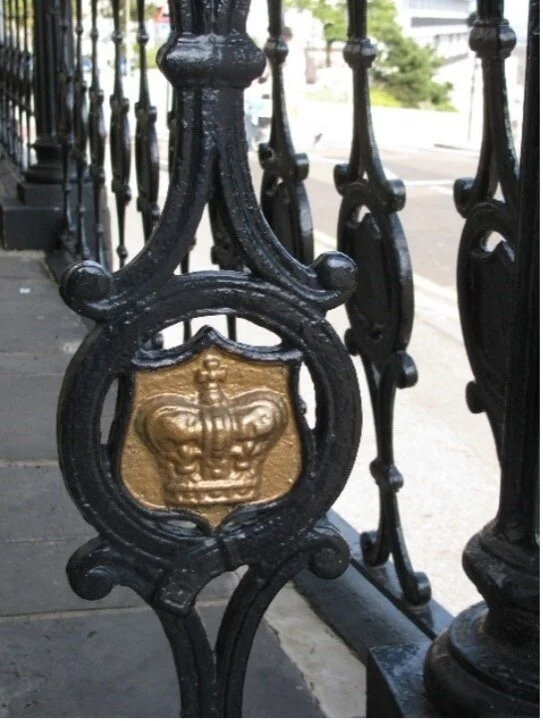
Fig 7: Decorative iron railing along the Royal Terrace

Fig 7: Decorative iron railing along the Royal Terrace


[1] Fanny notes in a letter to her sister Esther: “We are going to Southend tomorrow or the next day to look at a house which Papa thinks will answer for you all, and if we approve of it, I believe he will take it” (5 March 1812). See Sheila Johnson Kindred, Jane Austen’s Transatlantic Sister (hereafter JATS), (2017, 2018), 102-03.

[2] In 1813 the party included Palmer Esten but lacked Esther Esten and her son Hamilton who had returned to Bermuda.

[3] Since January 1812, Fanny had been making a home for Charles and their daughters aboard HMS Namur, the guard and receiving ship at the Nore anchorage offshore from Sheerness, Kent.

[4] Published by Kershaw & Son, no. 619.

[5] Advertisement for the Royal Hotel, 1813.

[6] Chelmsford Chronicle, 21 July 1813.

[7] Inserted in Europe Magazine, April 1813.

[8] Fanny to Esther Esten, 11 March 1814. See JATS, 156-157.

[9] See William Pollitt, Southend 1760-1860 (1939), 26.

[10] Fanny to James Esten, 21 January 1812. See JATS, 101.

[11] Fanny to Esther Esten, 5 March 1812. See JATS, 103.

[12] “A Letter from Mrs George Austen to Anna Lefroy,” The Jane Austen Society Report for 2003, 228.

[13] Print, 1808.

[14] See Michael Slater, Douglas Jerrold 1803-1857 (2000), 22.

[15] See paragraphs 3 and 4 above and Figs 1- 3.

[16] All page references are from Jane Austen: Lady Susan, The Watsons, Sanditon, ed. Margaret Drabble, Penguin Books (1974).

[17] The plot depends on there being occasions and places when characters can meet each other frequently, either by design or by chance. The close spatial relations among the Terrace, the Hotel and the Library facilitate such interactions and make them appear plausible. In chapter 7, we learn that “the Terrace was the attraction to all; every body who walked, must begin with the Terrace” (183). Charlotte has a tete-a-tete with Lady Denham on one of the green benches on the Terrace (186-189), an encounter which gives her an insight into Lady Denham’s character. Arthur Parker intends to “take several turns on the Terrace” (chapter 10, 201) every morning for exercise but one suspects his real motivation is to see who is out walking with whom and where are they are heading. Once the Parker siblings have secured lodgings for themselves on the Terrace, it is essential to their interests that they be able to monitor the comings and goings to the hotel and the movements of Mrs Griffith and her party, who are lodging in “the corner house of the Terrace” (chapter 11, 207).

[18] See notes 10 and 11.

[19] Anthony Edmonds and Janet Clark have focused attention on another seaside resort associated with Jane Austen. See Anthony Edmonds, “Edward Ogle of Worthing and Jane Austen’s Sanditon,” The Jane Austen Society Report for 1810, 114-128 and Janet Clark, “Jane Austen and Worthing,” The Jane Austen Society Report for 2008, 86-105.  

[20] Photo credits 5-7, Hugh Kindred

 Sophia Sawyer, Admiral’s daughter at Halifax, Nova Scotia

I have written about Fanny Palmer Austen’s role as a naval wife at Halifax, Nova Scotia, summer headquarters of the British Navy’s North American Station.  Recently, I was intrigued to learn more about another young woman, Sophia Elizabeth Sawyer, who, as the daughter of a naval officer, also spent time in Halifax, twenty-one years earlier than Fanny. Here is her story, another thread in the intricate fabric of naval family life.  

On 10 March 1770, Sophia Elizabeth Sawyer was born into a naval family of great wealth and comfort. She had both British and Portuguese ancestry, a situation explained by some unexpected events occurring eight years earlier. As a young British frigate captain on patrol off the coast of Portugal, her father, Herbert Sawyer, visited Lisbon, where he fell deeply in love with Anne Majendie, the daughter of a prosperous local wine merchant. The girl’s father objected to a marriage, not on grounds of personal merit, but due to Sawyer’s want of fortune. However, he quickly changed his mind when Sawyer co-captured a Spanish treasure ship, the Hermione, en route from Lima to Cadiz on 31 May 1762, carrying a cargo of over £500,000.00 in cash and gold bullion. Captain Herbert Sawyer received the enormous sum of £65,053 in prize money;[1] unsurprisingly, the marriage went ahead without delay.

By the time Sophia was eighteen, her father was Commodore[2] on the Navy’s North American Station. Her brother Herbert, three years older, had followed his father into the navy and was at times also on the Station, in command of a sloop. In October 1787, Sophia and her family were aboard her father’s flag ship, HMS Leander (50 guns), en route from Quebec to Halifax, when a catastrophe occurred. The ship struck a rock in the Gulf of St Lawrence and came very close to being lost. In this dire situation, the Sawyers had to quit the Leander and took refuge on board a smaller accompanying vessel, HMS Pegasus (28 guns). The Pegasus was commanded by no ordinary captain, but by the handsome, twenty-two-year-old Prince William Henry, later King William IV of Great Britain. Once Sophia recovered from the trauma of near disaster, she may have reflected how romantic it was to be rescued by a real prince! Moreover, he was a handsome prince, about 5 foot 8 inches high with a good complexion and fair hair.  

The fleet from Quebec reached Halifax on 26 October.[3] In welcoming a prince of the blood, Halifax was transformed and transfixed. The societal elite rose to the occasion with a patriotic fervour. In the course of 10 days there were three balls and suppers given in the prince’s honour, as well as a ceremonial welcome, including military manoeuvres and an official address from Governor Parr. Prince William also attended private suppers at the homes of the Governor, Commissioner Duncan of the Halifax Dockyard and the Commodore, Sophia’s father.

Fig. 1: The Commissioner’s House,[4] where one of the balls was held.

Fig. 1: The Commissioner’s House,[4] where one of the balls was held.

Sophia was lively, beautiful and vibrant, and described in local military circles as “a very handsome, fine woman.”[5] The excitement for her and other genteel young women must have been palpable as they anticipated the elegant events they would be attending. Sophia had certain advantages due to her father’s status as Commodore. Her family had living quarters reserved for them in a wing of the Naval Hospital at the north end of the Dockyard, and here Prince William dined with the Commodore, en famille, on the day of his arrival. He dined again with Commodore Sawyer on 2 November, though whether Sophia was present or not is uncertain.

Fig. 2: General William Dyott, formerly Lt. Dyott.[7]

Fig. 2: General William Dyott, formerly Lt. Dyott.[7]

We have Lt William Dyott, recently posted to Halifax with a detachment of the 4th Regiment, to thank for the chatty and enthusiastic entries in his diary which describe the festivities during Prince William’s visit. The Governor was the first to host an evening ball at his official residence close to the Grand Parade and St Paul’s Church.  According to Dyott, “His Royal Highness came about half seven and almost immediately began country dances with Miss Parr, the Governor’s daughter. We changed partners every dance; he danced with all the pretty women in the room and was just as affable as any other man. … Supper [was served] about twelve. A most elegant thing, near sixty people sat down.”[6]  

The Prince would have opened the country dancing with Miss Parr, as a matter of courtesy, given her father’s rank. Sophia was no doubt one of the “pretty women in the room” who had occasion to dance with the Prince, when she was not engaged by one of her father’s naval officers or one of the red-coated army officers from the 4th, 6th, or 57th regiments currently serving in Halifax.

November 5th was the day set aside for the official civic welcome. Sophia would have been well-positioned to observe the sights and sounds of the ceremony from her father’s vessel. At 2:15 pm Prince William left the Commodore’s ship in his own barge, manned by a crew wearing “handsome caps of black velvet with a silver ornament [at the] front, [incorporating] the King’s arms most elegantly cast.”[8] Every ship in the fleet manned its yards.[9] Their captains, positioned in their own barges, hoisted the Standard of England, ready to salute the Prince as he passed by. Members of the garrison could be seen lining the streets all the way from Government House down to the wharf, where Prince William would be landing. Soon, over the water echoed the sound of three field pieces firing a royal salute to mark his arrival, and as he moved through the lines of troops towards Government House the regimental bands struck up “God Save the King.” A noisy salute by the twenty-four pounders from the fort on the Citadel Hill above the town signaled Prince William’s entry to Government House to receive the civic address. That evening the town gave a ball, a large affair for 300 people.

Two days later the Commissioner of the Dockyard, Henry Duncan, hosted a ball at his handsome official residence. Built in 1785-6 in the classical style, it was well-positioned at the south end of the Yard, from where it looked down into the harbour towards the town. Lt. Dyottt was asked to “manage the dancing” and arrived to find “the Commissioner’s house and dockyard most beautifully illuminated.”

The dancing began soon after 9:00 pm and once again the Prince danced with great energy and enthusiasm.  Dyott reports that: “the last dance before supper at the Governor’s and [that night] at the Commissioners, his Royal Highness, Major Vesey, myself and six very pretty young woman danced “Country Bumpkin” for near an hour.”[10] Sophia was very likely one of the ladies dancing this reel with Dyott, Vesey and the Prince.  She was very attractive, enjoyed dancing and was of such a rank in local society that it would be appropriate to include her.

It was Admiral Sawyer’s turn to entertain the Prince on 9 November. The ever-social Lt Dyott was in attendance and described the proceedings thus: “The company was not so numerous as at the Governor’s, the house not being large. We had a very pleasant ball; Country Bumpkin, the same set, and a devilish good supper. We danced after supper and til four o’clock. ... I never saw people so completely tired as they all were.”[11]

It is intriguing that “the same set” danced the Country Bumpkin for the third time. What a pleasure for Sophia to be one of a select group, at a ball planned and hosted by her own family. This was to be Prince William’s last entertainment in Halifax as the Pegasus sailed early on the morning of 12 November.  Thus ended 17 heady days of elegant balls, suppers and civic ceremonies. The social elite of the town returned to its more modest lifestyle.

Tragically, Sophia’s moment in the sun was followed swiftly by illness and death.  According to Lt. Dyott, she had a swelling in her arm, on which a local doctor operated. The wound did not heal, instead Sophia developed a fever, and died on 31 January 1788. Lt Dyott mourned her loss, describing Sophia as “a most amiable, good, deserving young woman.” Asked to be a [pall]bearer at her funeral, he wrote in his diary: “I cannot say I ever felt more in my life than on the occasion, when I reflected that about three months before I was dancing with her, and that now I was attending her to her grave.”[12]    

St. Pauls.png

Fig. 4: St Paul’s Church, Halifax, where Sophia Sawyer’s funeral was held.[13]

Memorial.jpg

Fig. 5: Sophia Sawyer’s Memorial, St Paul’s Church, Halifax.

Lt. Dyott described the funeral. “The procession was led by the Bishop and the rector, then the body with eight honorary pall bearers, consisting of two navy officers and two army officers. “The under bearers were the Admiral’s barge crew, with white trousers, white shirts with a piece of love ribbon tied round the left arm, black velvet caps and white tied round them. … After the body, Mr. d’Acres, secretary to the Admiral, as chief mourner; next the nurse and Miss Sawyer’s maid in deep mourning and white hoods. After the two women, [the most senior naval and army officers], General Ogilvie and the Commissioner and the Governor by himself. All with white hat-bands and scarfs.”

Next came those who had known and loved Sophia best. “Three or four of the family, [were followed by] some officers belonging to the Admiral’s ship, with hat bands and scarves. After them [came] almost all the officers belonging to the fleet; many of the garrison; all the people of the town who were acquainted with the Admiral, and to close the whole, a long string of empty carriages.” When the funeral party entered the church, the organist played a solemn dirge. The service was then performed. Lt Dyott reflected that he “never saw so much grief as throughout the whole congregation.”[14] Sophia was interred in the crypt of St Paul’s Church.[15] Her father, Admiral Sawyer, returned to England without orders in August 1778 and never went to sea again. 

Fig: 6: Admiral Herbert Sawyer, c. 1811, Charles Austen’s Commander–in-Chief on the North American Station and brother of Sophia.[18]  

Fig: 6: Admiral Herbert Sawyer, c. 1811, Charles Austen’s Commander–in-Chief on the North American Station and brother of Sophia.[18]  


In the years to come, there was a link in friendship between Fanny Palmer Austen and Sophia’s elder brother, Rear Admiral Herbert Sawyer, who was Charles Austen’s commander-in-chief on the Station during 1810-11. Fanny liked him. She referred to him in her letters as “dear Admiral Sawyer,”[16] and empathized when his wife was too sick to join him on a subsequent posting to Cork, the headquarters of the Irish Station.  Perhaps Fanny reminded the Admiral of his sister, Sophia. Like Sophia, Fanny was “an amiable, deserving young woman.” Moreover, Fanny was a valued participant in the social life of the North American Station, like Sophia had been. In Fanny’s letters, she spoke enthusiastically of a “splendid ball” she had attended in Halifax at Government House.[17] Sophia had danced and dined with pleasure at a Government House event, twenty-two years earlier. This is a poignant parallel in the lives of two elegant and admirable young women, both who charmed the North American naval community.


[1] The prize money amounted to over £9 million pounds at today’s prices.  

[2] He was the senior captain on the Station in charge of a group of 3-4 ships.

[3] The fleet also included the Resource (28 guns) and the Weasel sloop. The much-battered Leander was towed to the Halifax Dockyard and hove down, where her bottom was discovered to be in a most shattered condition.

[4] “The Commissioner’s House in the Naval Yard, Halifax” The Naval Chronicle, February 1804.

[5] William Dyott, Dyott’s Diary 1781-1845 [here after Diary], ed. Reginald W. Jeffery, London, 1907, 47.

[6] Diary, 36-7. I have made small corrections in Lt Dyott’s punctuation.

[7] Engraving of General Dyott, frontispiece, Dyott’s Diary.

[8] The coxswain, who steered the boat, wore a gold ornament on his velvet cap. 

[9] The men would be positioned aloft, evenly spaced across all the yards, which were the cross spars on the masts of a square-rigged ship from which its sails were set.

[10] Diary, 43.

[11] Diary, 45

[12] Diary, 47.

[13] Attributed to Amelia Almon Ritchie, thought to be a copy of the same scene by William Eager, her teacher.

[14] Diary, 47-48.

[15] Her memorial can be seen inside the door into the sanctuary, on the wall to the right.

[16] See Sheila Johnson Kindred, Jane Austen’s Transatlantic Sister, [hereafter JATS], MQUP, 2017,2018, 127.

[17] JATS, 53.

[18] Admiral Sawyer was painted by Robert Field in Halifax.

Fanny Palmer Austen: Challenges and Achievements in Making a Family Home Onboard HMS Namur

This month I helped the Chatham Historic Dockyard, Chatham, Kent, England celebrate their new exhibition, Hidden Heroines: The untold stories of women of the Dockyard. Here is the text from my talk on June 23 which was followed by a live Q&A.   For the video of this event, visit the Chatham Historic Dockyard website.

Fig. 1: Fanny Palmer Austen[1]

Fig. 1: Fanny Palmer Austen[1]

Fanny Palmer Austen was a young woman who had a unique connection to the Chatham Dockyard. She was never a flag maker in the Sail and Colour Loft or employed in Spinning Rooms as other 19th century women in this exhibition were. Fanny counts as one of the hidden heroines because of her life on HMS Namur.

The Namur was known as one of the most famous ships built at the Chatham Dockyard. When her husband, Captain Charles Austen, was in command from late 1811-1814, the capable Fanny undertook the unusual task of making a family home for him and their young daughters on board. Her candid and articulate letters written to family members reveal her opinions and sentiments about the challenges she faced. She tells us what it was like to be a naval wife and mother living at sea during the later years of the Napoleonic Wars. In fact, she provides a strikingly realistic picture of naval family life on board as seen from a woman’s perspective. Let me take you on board to discover how Fanny coped with this exceptional situation.

When Charles was commissioned into the Namur, Fanny must have wondered about the size of the ship and the vessel’s current naval duties. Launched at Chatham in 1756, the Namur saw action in nine sea battles.  Originally a three-decker ship of 90 guns, in 1804 she was reduced to a two decker with 74 guns. The Namur rode at anchor at the Great Nore, an area located offshore three miles northeast from Sheerness, Kent. She was in use as a receiving ship for sailors - both volunteers and pressed men - waiting to be assigned to warships needing crews. She also acted as a guard ship, the first line of defence against any enemy vessels that might attempt an attack on the Sheerness and Chatham Dockyards or an advance upon London further up the Thames. So, there was an element of risk where Fanny was to be located.

Fig. 2: HMS Namur as a ship of 90 guns. She is the largest vessel in the harbour.[2]

Fig. 2: HMS Namur as a ship of 90 guns. She is the largest vessel in the harbour.[2]

Once aboard, household management at sea tested Fanny’s ingenuity and patience. An initial priority was reconfiguring the captain’s quarters in the stern of the ship to best suit her family’s needs and comforts. She no doubt liked the look of the captain’s day cabin, with its large glass windows that provided a panoramic view of the Nore anchorage, and the opportunity for access to an exterior gallery. However, this room was sometimes used for Charles’s official business, so the adjacent areas became the family’s private preserve. Most likely there were existing walls which marked out a state room or sleeping cabin on one side and another cabin on the other. Fanny could complete the division of the remaining area assigned to the captain, by directing the placement of movable wooden panels. Fortunately, the family quarters enjoyed some measure of quiet and seclusion. They were only accessible from the quarter deck, which was the exclusive domain of the officers. An armed marine stood on guard at the entrance to the captain’s quarters, another unique feature of living on board.

So, what did Fanny think about what she had accomplished? I would like to read you some passages from Fanny’s letters, so you can hear her voice. Initially she was enthusiastic about the adaptations to make a family living space. She wrote to her brother-in-law, James Esten, in Bermuda. Mama & Palmer [her nephew] have been staying with us, … & we mean to keep them as long as the Holidays will permit: they are very much pleased with our habitation, which, now that we have got things to rights, we find extremely comfortable (21 January 1812). During a visit by her father several months later, Fanny noted: Papa is very much pleased with our accomodations & enjoys sleeping in a Cot extremely (5 March 1812).This was quite a feat for Fanny’s aging father, given that he was sleeping in a small canvas bed, only three feet wide, which swung suspended from the ceiling. Other members of the Austen family expressed an opinion. Charles’s sister, Cassandra Austen, observed to a cousin that [Fanny] and [their] children are actually living with [Charles] on board. We had doubted whether such a scheme would prove practicable during the winter, but they have found their residence very tolerably comfortable & it is so much the cheapest home she could have that they are very right to put up with little inconveniences.[3] Three months later, Cassandra visited the Namur to see for herself what she called Fanny and Charles’s aquatic abode.

Fanny was initially pleased she had got things to rights with our habitation, that she had created an establishment where they could live and sleep in relative comfort. Unfortunately, problems arose which interfered with the smooth running of her household. Fanny required at least one female servant to help with childcare, to perform basic domestic tasks and, by times, to serve as her lady’s maid. Yet, competent servants willing to live and work at sea proved difficult to find and even harder to retain. As Fanny wrote: I am much teased in my domestic concerns …  and am at this moment without a Nurse. Though I [had] a very nice woman in that capacity, …some lady has most unhandsomely enticed her away from me, by holding out advantages which I could not (30 June 1814.)  As a result of her servant problems, Fanny took on more domestic tasks herself than would ordinarily be expected of a gentlewoman.

It did not help that the weather was changeable and sometimes exceptionally rough. Seasickness was a problem for which Fanny had no easy remedy. Her eldest girl, Cassy, was particularly vulnerable and Fanny hated to see her grow thin and look poorly. Nor did Fanny want her children to suffer on board in frigid weather when a damp chill penetrated and persisted. From 1813 onward Fanny regularly sent a daughter to spend time on shore with her aunts: Jane, the acclaimed novelist, and Cassandra Austen at Chawton Cottage in Hampshire or to Fanny’s sister, Harriet Palmer, in London. This distressed her. She missed her daughters terribly in their absence. Such arrangements made it impossible to maintain the family intimacy which Fanny so greatly valued.

Furthermore, her efforts to create a pleasing and peaceful atmosphere within their home space were sometimes frustrated by the darker side of naval life. She was living in a world where misdemeanors were punished swiftly and brutally. The Royal Navy required that instances of mutinous language and conduct, disobedience of orders, theft, inter-personal violence, drunkenness or riotous behaviour must be punished by public flogging. During Fanny’s tenure on board there were five occasions of the cruellest sort of punishment, known as flogging around the fleet. Presumably, Charles was able to warn Fanny in advance when a flogging was about to occur. Perhaps he even arranged for her to be on shore in nearby Sheerness. Yet inevitably there must have been times when there was no ready escape from the distressed cries of the punished. We do not know how Fanny managed to cope with the cruelty of flogging, with the sound of suffering, with the ominous pulsating of the drums which accompanied the lashings, all terribly disturbing noises for her and her children.

Other features of Fanny’s situation came to bother her over time. She was lonely in her isolation from genteel female company. She felt confined by the limited area of the ship where she could move freely, this being parts of the quarter deck and the poop deck above.

It may sound as if Fanny was having a terribly difficult time on board, but in between the situations which tried her patience and triggered her disappointment, were happier, more satisfying occasions. She helped to create an atmosphere of supportive friendliness for midshipmen, the young trainee officers under Charles’s tutelage.  As these young men received some of their instruction in the captain’s cabin, they must have also benefited from Fanny’s feminine attention. They in turn gave her a sense of community within the navy of the quarterdeck.

Fanny also appreciated Charles’s initiatives to bring civilizing influences to rough and rigorous shipboard life. There was a band of musicians on board, although Fanny’s father, while visiting the Namur, remarked on the indifferent talent of the clarinet player. Nonetheless, it was cheering to have a source of music, even if it fell far short of professional standards. Charles encouraged his sailors to present theatrical entertainments for the edification of the officers and men. This pleased Fanny, although on one occasion she notes: we were all disappointed for the Theatre was not finished, & consequently, they were obliged to postpone acting until next Monday (22November 1813). 

Best of all was the joy of the uninterrupted togetherness of her family.  Fanny and the little girls had the pleasure of Charles’s regular company. He was at hand to help with the children’s education, to play with them at bedtime, and to celebrate the milestones of their development, such as when the baby of the family, little Fan, born early December 1812, showed great determination to walk on her own. Fanny and Charles could also share in their children’s newfound pleasures, such as Cassy’s delight when she mastered the technique of leaving the ship by the bosun’s chair, which swung her out from the Namur’s main deck and swooped her down to a waiting tender that would take her to shore.

So why is Fanny to be seen as a heroine? She was brave to take on the project of creating a home for her beloved family on a working naval ship during wartime. She was courageous to take the chance of living with small children on a coastal guard ship, exposed to the possibility of attack from the enemy’s navy across the North Sea. Fanny was also heroic in the way she carried out her life distinct from the expected behaviour of naval wives, who made homes on land, where shops, services and supplies were readily accessible, where social routines were predictable and comforts dependably available.    

Finally, Fanny had the courage to commit to a lifestyle of immediate support for Charles, to be his affectionate companion and to encourage him during the hazards and uncertainties of his naval career, regardless of the risks to herself. She was his heroine, as well as ours.[4]


[1] Fanny’s portrait was painted by British artist, Robert Field, in Halifax in 1810. Private collection.

[2] “Town and Harbour of Halifax as they appear from the opposite shore called Dartmouth,” by Dominic Serres, 1762. Art Gallery of Nova Scotia.

[3] Cassandra Austen to Mrs George Whitaker (Phylly Walter), quoted in Austen Papers 1704-1856, ed. Austen-Leigh, (1942), 249.